Healius: Intuitive Enterprise Healthcare
End-to-End Application
Enterprise Platform
Healthtech / Enterprise healthcare – 2023–2024
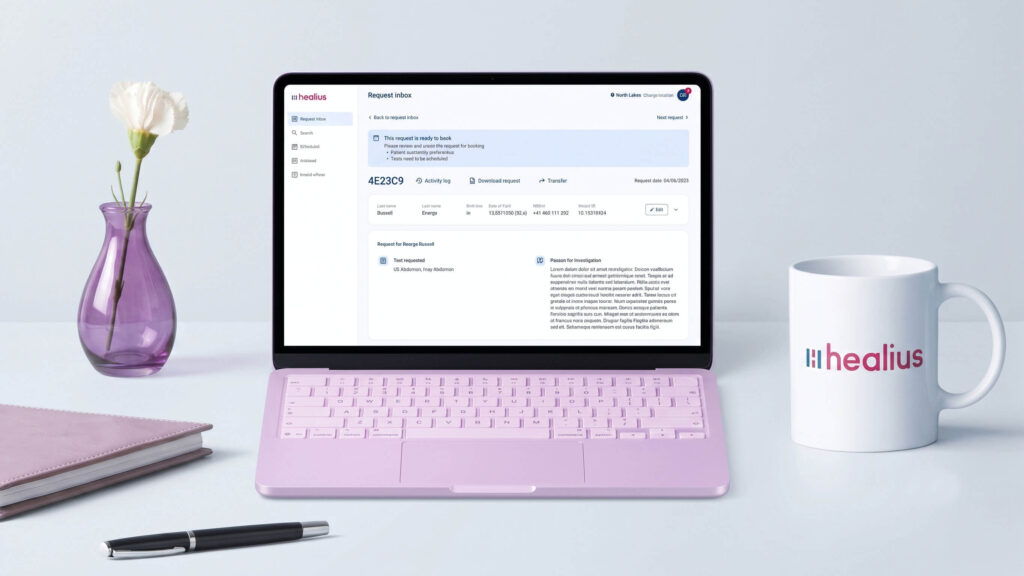
Highlight Overview
As the sole Australian-based UX/UI Designer at Neuronimbus, I was a primary design lead for Healius, one of Australia’s leading healthcare services providers. Clinical operators across labs, diagnostics, and early childhood therapy services were working inside disjointed legacy systems that demanded heavy manual tracking, buried critical patient data in text-heavy tables, and fell short of WCAG 2.2 accessibility standards — a real problem during long, high-pressure clinical shifts.
I led the redesign of a modernised Request Management dashboard, working closely with an internal Clinical Specialist Adviser to translate real clinical workflows into a flattened information architecture, an accessible design system, and a booking flow that gives clinicians and their patients clarity and control from confirmation through to appointment day.
Impact
- Task-to-completion time for metric entry dropped significantly, and standard data-entry errors decreased during rapid-fire clinical sessions.
- The design system unified six previously separate brand workflows into one governed platform, cutting design-to-development handoff time by 50%.
The Challenge
Clinical professionals needed a unified, frictionless environment to track patient booking requests and manage clinical workflows — but were stuck with disjointed systems built for individual brands rather than one platform.
The platform also had to flex across very different clinical settings — from fast-paced diagnostic labs to early childhood therapy environments — without losing consistency or compliance.
My Role & Method
Role: UX + UI Design, Visual Design, Design Systems Governance, Interaction Design, User Research, Prototyping & Testing
Tools: Figma, FigJam, Zoom
Rather than broad market research, discovery here was driven by close, internal collaboration with a dedicated Clinical Specialist Adviser — mapping exact clinical realities, regulatory guardrails, and operational needs from day one. That took the form of:
- Expert workflow mapping — walk-throughs of existing end-to-end clinical processes to pinpoint where legacy software caused bottlenecks.
- Cognitive load assessment — analysing which screens and data-logging tasks contributed most to practitioner fatigue and manual errors.
- Accessibility guardrail definition — establishing WCAG 2.2 and clinical safety requirements early, rather than retrofitting them later.
What I Found
Synthesising the workflow maps and guardrails with the Clinical Specialist Adviser surfaced three core, addressable issues:
- The workflow bottleneck — nested menus and rigid data entry ate into time that should have gone to patient care.
- The accessibility gap — failing contrast and readability metrics were a real physical strain, not just a compliance checkbox.
- Data fragmentation — critical patient trends were buried in text-heavy tables instead of being scannable at a glance.
The Solution
Flattened information architecture — replaced multi-level legacy menus with a persistent, high-level navigation scheme built for enterprise healthcare, surfacing active patient logs and trend metrics in under two clicks.
Contextual data prioritisation — restructured the layout hierarchy so critical visual metrics and active workflows sit in the main view, cutting time spent hunting for patient trends.
Accessibility-first UI — generous tap targets, scalable text, and clear visual zones built in from the first layout iteration, with a colour palette exceeding WCAG 2.2 AA contrast (4.5:1 minimum) for legibility under fluctuating lab lighting.
Governed design system — reusable input states, tables, and alert banners built to unify six previously separate brand workflows into one platform, using a clinical typographic scale (Roboto) tuned for split-second, accurate data scanning.
Unified booking flow — the high-fidelity dashboard lets clinicians view request details, patient booking preferences, and schedule appointments in one workspace. The booking confirmation flow (below) was designed to keep patients informed and in control at every step:
- Immediate confirmation — an automated SMS confirms the appointment as soon as the clinician secures the booking.
- Summary of key details — location, time, service type, and any preparation requirements, upfront.
- Upfront instructions — fasting rules, required documents, and other requirements surfaced early to remove guesswork.
- Post-booking flexibility — accessible options to reschedule or cancel if availability changes.
- Ongoing transparency — a sequential experience designed so patients feel informed and in control from booking through to walking in the door.
Outcome
The redesigned Request Management dashboard reduced cognitive load and administrative friction for clinical staff, while the governed design system cut the time needed to move from design to development across six unified brand workflows.
Need to elevate your digital project?
Let’s discuss how my design system, accessibility, and product strategy skills can help your team.