ivygo: Unlocking Monetisation, Reducing Risk & Enhancing Trust
UX Research
Web Application
UX Research & Product Strategy · B2C/B2B Web Application · EV Charging Marketplace · 12 weeks
Highlight Overview
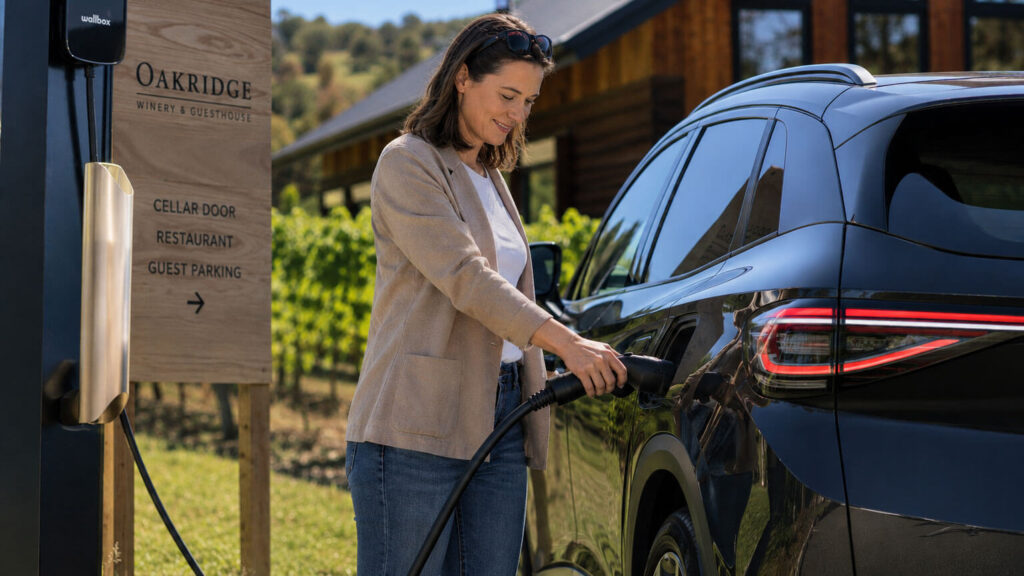
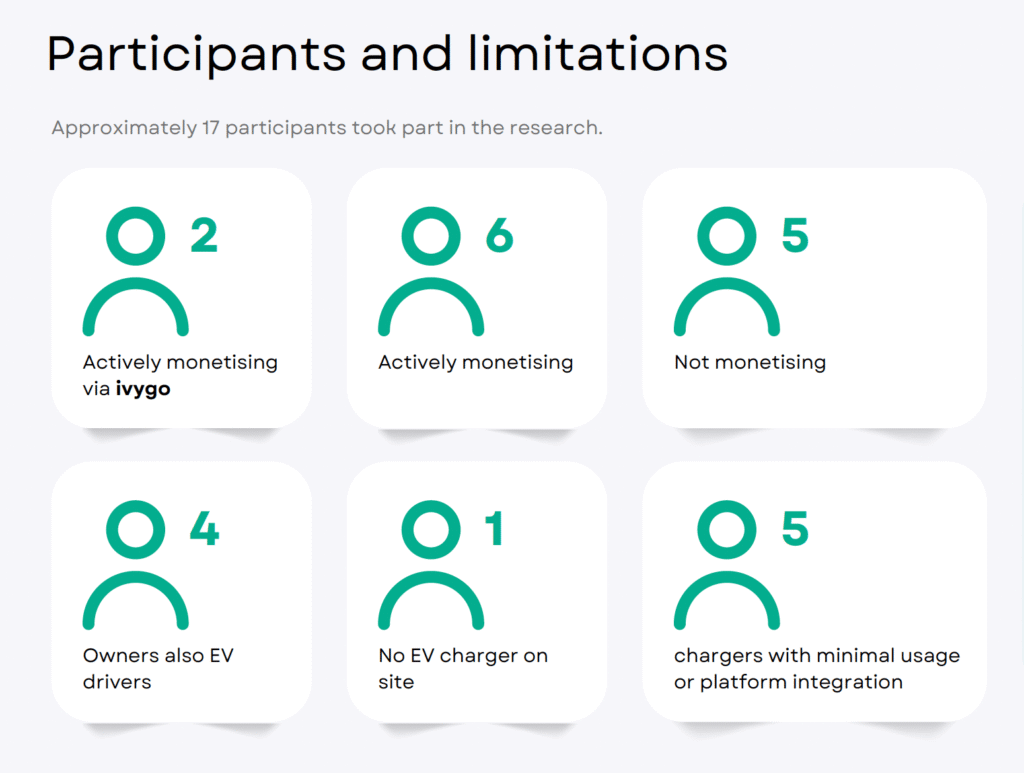
ivygo connects EV drivers with charging stations hosted by small hospitality businesses — wineries, regional cafes, boutique B&Bs. The app itself handles bookings and payments smoothly, but most hosts leave their chargers on “Free” or entirely unmanaged. Through 17 in-depth interviews with small business owners and regional EV drivers, I identified why: hosts weren’t held back by the technology itself, but by technical anxiety, paperwork stress, and a fear of looking greedy to their guests — a pattern I termed the “Passive Plateau.”
I led the research and product strategy to move hosts from total hesitation to full financial confidence, defining the exact features, security controls, and release sequencing the development team needed to build.
Instead of designing screens, my job was to turn what hosts were feeling — their worries and hesitations — into a clear plan the development team could actually build. That plan had three parts: a simple dashboard so hosts could see what’s happening in real time, a tool that shows them exactly when their investment pays off, and automatic safeguards running quietly in the background to protect them from any financial or technical risk.
These three feature pillars became a 12-month, three-phase release roadmap handed to the ivygo founder and CEO Julie Perrissel for review and roadmap consideration with her development team.
The Challenge
Australians are adopting EVs quickly, and travellers actively look for wineries, regional cafes, and boutique stays where they can charge during a road trip. Hosts see this as a strong marketing opportunity — but experience the reality of running a charger as an unpredictable, confusing technical chore, and most default to giving power away for free rather than deal with it.
My Role & Method
Role: UX/UI Specialist & Product Strategy Lead
Tools: Miro, Gemini AI, Google Docs, Zoom
This project was research- and strategy-led rather than a tangible product concept delivery— my focus was defining what the product needed to do and in what order, not producing high-fidelity UI.
I ran a three-stage process:
- Discover: I conducted remote interviews and phone calls directly with small business hosts and regional EV drivers, respecting how limited their time was. I personally gathered and analysed a meaningful share of the wider research cohort’s overall data.
- Synthesise: I pooled findings with a shared research cohort into a single Miro whiteboard, clustering recurring quotes and pain points to confirm which anxieties were individual noise versus real, shared market patterns.
- Product Strategy: I mapped the emotional journey hosts go through, then translated the points where they get stuck into concrete system features, security controls, and a release schedule for engineering.
A recruitment challenge, handled adaptively: research launched during a major holiday travel rush, when small business owners had almost no time to respond to cold outreach. I shifted recruitment to professional participant networks (Askable) and my own professional network, which kept the data high-quality without adding to hosts’ already stretched schedules.
What I Found
Clustering the interview data (source: 17 host/driver interviews, synthesised with the research cohort on Miro and Gemini AI) surfaced three consistent, quoted host anxieties:
- Fear of appearing greedy: “I want people to feel as though they have had a luxurious experience… I worry monetisation could appear greedy.”
- No appetite for admin: “I like that it’s a hands-off experience. I don’t need the extra admin load.”
- Real financial risk aversion:“We can’t incur a $100 bill that we swallow.”
I distilled these into three host user persona archetypes to keep the later strategy grounded in real behaviour rather than an average user:
- Liam – forward-thinker, wants EV charging statistics on customer use but has none
- Maya – busy winery host, has no time for maintaining spreadsheets from EV charging customer usage, worried about overloading her kitchen’s power grid
- Avery – reluctant host, avoids EV charging pricing conversations with customers entirely by giving charging away free.
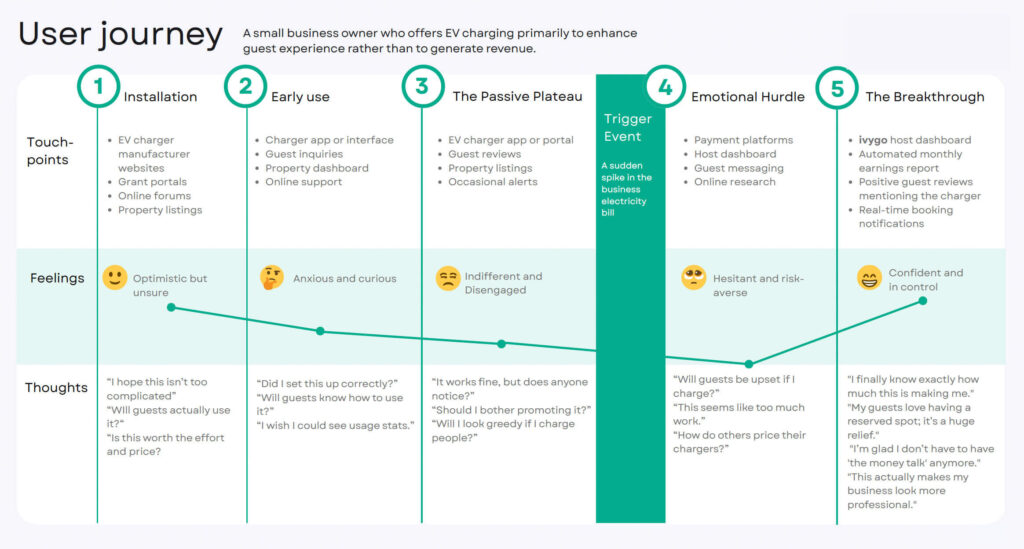
Mapping Maya’s journey across five phases showed the core problem clearly: host confidence drops sharply right after setup and stays low — the “Passive Plateau” — until a painful trigger (typically a shock electricity bill) forces the host to act.
A hidden-demand story
One Airbnb host hadn’t installed EV charging at all. But a guest found an unused outlet inside the property’s meter box — not intended for public use — and plugged in anyway.
Rather than treat it as a problem, the hosts saw it for what it was: proof that demand was already there, just unmet. It prompted them to plan a proper installation, including guest-facing access and a secure lock for the meter box.
This is the gap ivygo closes — turning invisible, ad hoc demand into a safe, intentional offering hosts control.
The Proposed Solution
I defined feature pillars, each targeting one of the hidden fears surfaced in research, and translated them into concrete product requirements for engineering:
- Real-Time Command Center
Replaces guesswork with a live dashboard:- A high-contrast earnings tracker (today/week/month)
- A “heartbeat” status indicator confirming hardware is online and synced
- Directly answers the anxiety behind Liam’s “I’m flying blind.”
- Payback Visualiser
An interactive onboarding tool: hosts enter their setup cost and see an automatically calculated 12–24 month break-even timeline against tourism metrics.
Turns an abstract investment decision into a concrete, provable ROI case — the missing piece stopping hosts from committing in the first place. - Invisible Grid Intelligence
Removes host risk automatically, rather than asking hosts to manage it themselves:- Kitchen Failsafe — throttles vehicle charging if a property’s power load nears capacity, protecting Maya from a tripped breaker mid-service
- Bill Shield — auto-pauses charging if grid costs spike, so the business is never out of pocket relative to what the driver pays
- A dedicated B2B web dashboard
Informed directly by how hosts already run their properties day-to-day. Charger management sits alongside the other software tools they use, rather than becoming one more disconnected system to check.
The Business Outcome
The Airbnb meter-box story landed differently than expected — as an EV driver herself, ivygo’s founder had done the same thing: sourcing power from an unsecured outlet when no proper charging was available. Hearing it reflected back through the research confirmed what she already knew from lived experience — the workaround wasn’t a one-off, it was a symptom of real, unmet demand, and the product she’d built was solving a problem she’d personally felt.
That personal recognition gave the roadmap conversation immediate credibility. Rather than propose everything at once — a real risk with an already tech-hesitant audience — I sequenced the three pillars into a phased 12-month roadmap for the client:
- Phase 1 — Build Confidence (Months 0–3)
- Core host dashboard with live usage metrics
- Simplified step-by-step pairing wizard to remove setup anxiety
- Phase 2 — Remove Friction (Months 3–6)
- Automated payment splitting and auto-generated monthly CSV accounting reports — removing the awkward pricing conversations hosts like Avery actively avoid
- Live ROI payback graph
- Phase 3 — Strategic Growth (Months 6–12)
- Advanced Smart Power controls and solar-first optimisation
- Downloadable “EV Friendly” badging for listings on platforms like Booking.com or Airbnb
Need to elevate your digital project?
Let’s discuss how my design system, accessibility, and product strategy skills can help your team.